
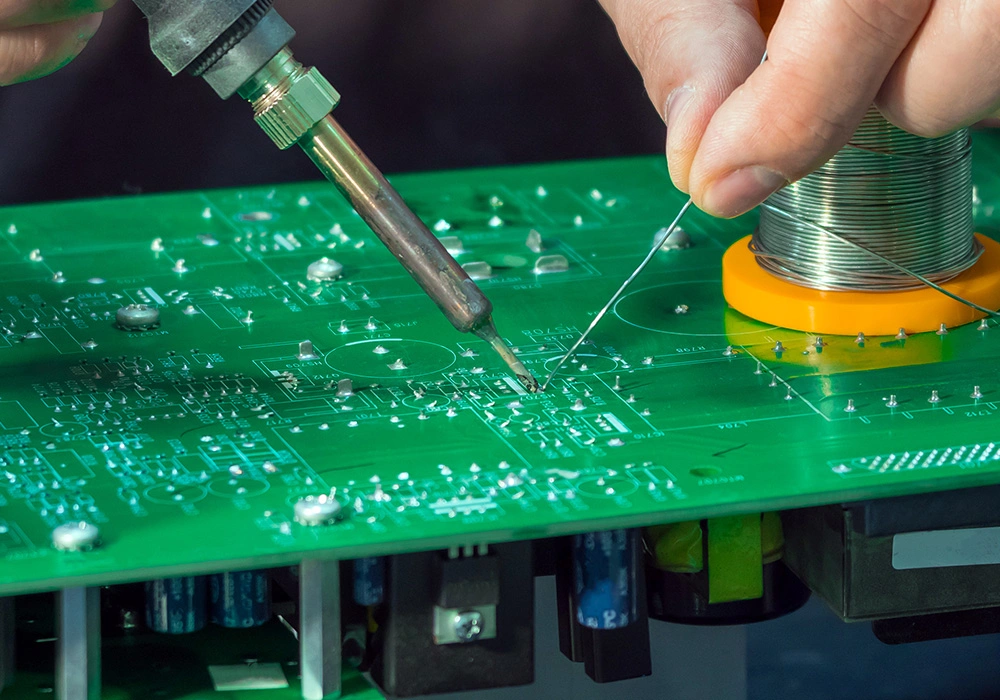
Global PCB production crossed $90 billion in 2024, and Prismark projects continued growth through 2026 as AI servers, EVs, and 5G infrastructure pull harder on board capacity. For hardware teams sourcing partners this year, the question isn’t whether to outsource — it’s which factories can hit IPC Class 3 reliability without missing the launch window.
Ranks the top 10 PCB manufacturers in the world for 2026, weighing capability depth, certifications, customer rosters, and turnaround speed. You get a side-by-side comparison table, vetted shortlist with industry fit notes, a buyer’s checklist for building your RFQ list, and answers to the questions procurement teams ask most often.
The list spans Taiwan, mainland China, Japan, Europe, and North America so you can match supplier geography to your project’s logistics and IP requirements.
Top PCB Manufacturers in the World at a Glance
| Company | HQ | Specialty | Best For | Lead Time |
| Zhen Ding Technology | Taoyuan, Taiwan | HDI, SLP, flex | High-volume smartphone & AI server PCBs | 2–6 weeks |
| Unimicron Technology | Taoyuan, Taiwan | IC substrates, HDI | Advanced packaging, data center | 3–6 weeks |
| PCBSync | Shenzhen, China | Turnkey PCB + assembly | Prototype to mid-volume turnkey builds | 24 hrs – 4 weeks |
| Nippon Mektron | Tokyo, Japan | Flexible PCBs | Automotive and smartphone flex | 4–8 weeks |
| TTM Technologies | Santa Ana, CA, USA | Aerospace/defense, RF | US-domestic, ITAR programs | 3–8 weeks |
| AT&S | Leoben, Austria | HDI, IC substrates | European OEMs, computing | 3–6 weeks |
| Tripod Technology | Taoyuan, Taiwan | Multilayer, HDI | Networking, server, automotive | 3–6 weeks |
| Compeq Manufacturing | Taoyuan, Taiwan | HDI, multilayer | Consumer, automotive volumes | 3–6 weeks |
| Ibiden | Gifu, Japan | FCBGA substrates | Server CPUs, AI accelerators | 4–8 weeks |
| Würth Elektronik | Niedernhall, Germany | Prototype-to-series, IMS | EU industrial and medical | 1–4 weeks |
Lead times are typical ranges for standard work; complex stack-ups, exotic materials, and high layer counts extend timelines.
Selection Methodology
This list was assembled from publicly available capability data, certification registries (ISO, IPC, IATF), customer disclosures, and industry market-share reports from Prismark and N.T. Information. Four factors carried the most weight: capability depth across layer count, materials, and HDI/flex/substrate technology; certifications relevant to high-reliability industries; breadth of disclosed customer base; and ability to scale from prototypes through volume production. Geographic coverage was a tie-breaker so buyers can match supplier location to logistics, tariff, and IP constraints. Revenue rankings shift year to year, but capability fit matters more for most procurement decisions in the 2026 cycle.
1. Zhen Ding Technology
Zhen Ding (ZDT) tops global PCB rankings on revenue, supplying high-density boards and substrate-like PCBs (SLP) for the world’s leading smartphone, tablet, and AI server brands. Spun out of the Hon Hai (Foxconn) group, the company runs Tier-1 plants across Taiwan and mainland China.
- Founded / HQ: 2006 / Taoyuan, Taiwan
- Key Services: HDI PCB fabrication, flexible PCBs, IC substrates, SLP, rigid-flex
- Notable Capabilities: Any-layer interconnect, mSAP processing for ultra-fine line widths, high-frequency materials, automotive-grade lines, large-format panels for server applications
- Industries Served: Smartphones, tablets, AI servers, automotive ADAS, consumer electronics
- Best For: OEMs needing high-volume HDI or SLP at smartphone-scale capacity, where capability depth outweighs prototype-friendly MOQs
2. Unimicron Technology
Unimicron has built its global presence on HDI and IC substrate capacity, supplying advanced semiconductor packaging customers including several Tier-1 foundries and AI accelerator vendors. The company operates fabs across Taiwan, mainland China, Germany, and Japan, giving multinational buyers regional sourcing flexibility.
- Founded / HQ: 1990 / Taoyuan, Taiwan
- Key Services: HDI PCBs, IC substrates (FCBGA, FCCSP), rigid-flex, high-speed multilayer
- Notable Capabilities: Any-layer HDI down to ultra-fine line widths, IC substrate volume production for advanced-node packaging, high-Tg materials for server work, IATF 16949 lines for automotive
- Industries Served: Semiconductors, data center networking, automotive electronics, telecom, consumer
- Best For: Buyers needing IC substrate or HDI volumes tied to advanced silicon, where multi-region capacity matters
3. PCBSync
PCBSync runs a one-stop turnkey model — PCB fabrication, components sourcing, and assembly under a single contract — that suits NPI teams pulling builds in tight windows. The Shenzhen base sits inside the global components ecosystem, shortening BOM clearance on mixed domestic-and-imported parts.
- Founded / HQ: 2005 / Shenzhen, China
- Key Services: PCB manufacturing (1–56 layers), SMT/THT/BGA and mixed-tech assembly, components sourcing, box build, cable harness
- Notable Capabilities: FR4, HDI, flex, rigid-flex, Rogers, ceramic, aluminum, copper-core, and heavy copper boards; AOI, X-ray, ICT, flying probe, 3D SPI, and functional test in-house
- Certifications: ISO 9001, IPC-A-610 Class 3, RoHS compliant
- Industries Served: Automotive, medical, aerospace, industrial, IoT, robotics, telecom, drone, military
- Best For: Hardware teams running prototypes through mid-volume turnkey builds who want fabrication, sourcing, and PCBA on one PO — PCBSync’s turnkey PCB services cover the full chain. Public customer references include Honeywell, Siemens Healthineers, Analog Devices, Continental, and Fermilab.
4. Nippon Mektron
Nippon Mektron — often shortened to Mektec — holds the largest share of global flexible PCB production, with longstanding programs at automotive and smartphone OEMs that depend on high-volume flex. The company’s scale in roll-to-roll flex is difficult to match elsewhere.
- Founded / HQ: 1969 / Tokyo, Japan
- Key Services: Flexible PCBs, rigid-flex, multilayer flex, flex circuit assemblies
- Notable Capabilities: Roll-to-roll flex manufacturing at scale, multilayer flex with embedded components, automotive-qualified lines for camera modules and battery management, IATF 16949 quality systems
- Industries Served: Automotive ADAS and cameras, smartphones, wearables, industrial sensors, medical
- Best For: Programs needing flex PCB volumes at automotive-grade reliability or smartphone production cadence
5. TTM Technologies
TTM Technologies is North America’s largest PCB manufacturer, with significant capacity dedicated to aerospace, defense, and high-reliability RF backplanes. The company runs multiple ITAR-registered domestic facilities alongside international plants, letting defense primes keep sensitive programs onshore while still tapping commercial-volume capacity.
- Founded / HQ: 1978 / Santa Ana, California, USA
- Key Services: Rigid multilayer PCBs, RF and microwave boards, high-layer-count backplanes, IC substrates, integrated electronic assemblies
- Notable Capabilities: AS9100 aerospace quality system, MIL-PRF-31032 and MIL-PRF-55110 qualifications, backplanes exceeding 80 layers, exotic dielectrics including PTFE and hybrid stack-ups
- Industries Served: Aerospace and defense, networking and data center, medical, automotive
- Best For: US-domestic content programs, defense primes needing trusted-source PCBs, and RF/microwave-heavy designs
6. AT&S
AT&S (Austria Technologie & Systemtechnik) is Europe’s largest PCB and IC substrate manufacturer, with deep specialization in HDI, any-layer, and substrate technologies for advanced computing. The company has invested heavily in capacity expansion across Asia to support AI accelerator and high-performance computing customers.
- Founded / HQ: 1987 / Leoben, Austria
- Key Services: HDI PCBs, IC substrates (FCBGA, FCCSP), mSAP boards, modules with embedded components, medical-grade PCBs
- Notable Capabilities: Ultra-fine line HDI, embedded component packaging (ECP), high-speed materials, fabs in Austria, India, China, Malaysia, and Korea
- Industries Served: Mobile devices, computing, automotive electronics, industrial, medical
- Best For: European OEMs needing regional HDI capacity, and advanced computing programs sourcing IC substrates
7. Tripod Technology
Tripod Technology is a Taiwan-based PCB heavyweight with broad capability across rigid multilayer, HDI, and high-frequency boards. The company has built strong programs in automotive electronics and networking infrastructure, supported by fabs in Taiwan and mainland China.
- Founded / HQ: 1990 / Taoyuan, Taiwan
- Key Services: Multilayer rigid PCBs, HDI, high-frequency RF and microwave boards, automotive-grade PCBs
- Notable Capabilities: High-layer-count multilayer fabrication, automotive IATF 16949 lines, mass-lamination for backplane and base station programs, mature DFM and engineering support
- Industries Served: Automotive ADAS, networking and 5G infrastructure, servers, industrial, consumer electronics
- Best For: Networking, server, and automotive OEMs needing high-volume multilayer at Tier-1 quality
8. Compeq Manufacturing
Compeq Manufacturing carries five decades of multilayer and HDI experience, with a customer base spanning consumer, automotive, and high-frequency networking. It is one of Taiwan’s oldest PCB makers and publicly listed on the Taiwan Stock Exchange.
- Founded / HQ: 1973 / Taoyuan, Taiwan
- Key Services: HDI PCBs, multilayer rigid boards, IC substrates, automotive PCBs
- Notable Capabilities: Mature HDI lines including any-layer, automotive-grade qualification, high-Tg and high-speed materials for server and networking work, plants in Taiwan and mainland China
- Industries Served: Consumer electronics, automotive infotainment and ADAS, networking, server, mobile devices
- Best For: Mid- to high-volume HDI buyers wanting a Taiwan-headquartered partner with long-running quality systems and a broad material library
9. Ibiden
Ibiden’s PCB and IC substrate business is rooted in more than a century of materials and electronics manufacturing. The company holds a strong franchise in high-end FCBGA substrates used in server CPUs and AI accelerators, and ranks among the most respected names in the substrate market.
- Founded / HQ: 1912 / Gifu, Japan
- Key Services: IC substrates (FCBGA, FCCSP), HDI PCBs, multilayer rigid
- Notable Capabilities: Industry-leading FCBGA substrates for server-class CPUs, ultra-fine line capabilities, proprietary build-up dielectric materials, sustained R&D investment in substrate technology
- Industries Served: Server CPUs and AI accelerators, data center, networking, industrial computing
- Best For: Server, AI, and HPC programs sourcing advanced FCBGA substrates, where substrate roadmap matters as much as price
10. Würth Elektronik
Würth Elektronik’s Circuit Board Technologies division is one of Europe’s go-to PCB sources for industrial, automotive, and medical buyers needing local engineering support and short logistics chains. The Würth Group is a global components company, and the CBT arm operates multiple specialized plants across Germany.
- Founded / HQ: 1971 / Niedernhall, Germany
- Key Services: Rigid multilayer PCBs, HDI, flex, rigid-flex, thermal management (IMS) PCBs, prototypes through series
- Notable Capabilities: Strong DFM consulting and engineering support, IATF 16949 automotive lines, IPC Class 3 medical capability, in-region German plants for fast turnaround on critical work
- Industries Served: Industrial automation, automotive electronics, medical devices, aerospace, LED lighting
- Best For: European OEMs needing local engineering support and prototype-to-series continuity inside the EU
How to Choose the Right PCB Manufacturer for Your Project
Even after narrowing a shortlist from the top PCB manufacturers in the world, picking the right partner depends on how well their capability stack maps to your program. Use the criteria below before sending RFQs.
Certifications & Compliance
ISO 9001 is table stakes. For medical, automotive, or aerospace work, look for IPC-A-610 Class 3 acceptance, ISO 13485, IATF 16949, or AS9100. Defense work typically demands ITAR registration and MIL-spec qualifications. Ask for current certificates with expiry dates rather than marketing claims.
Capability Match
Match the supplier’s typical work to your project. Layer count, finest line/space, controlled impedance tolerance, material library (FR4, Rogers, ceramic, polyimide), and assembly mix (SMT, THT, BGA, mixed-tech) all matter. A 56-layer HDI shop is overkill for a simple LED driver.
Lead Time & Turnaround
Quick-turn prototypes run 24–72 hours at specialist shops; production-grade builds usually take 2–6 weeks. Be explicit in your RFQ about which you need. Faster iteration during NPI can save weeks of program slip later.
Pricing Model & MOQ
Some manufacturers quote per-square-meter, others per-piece. Ask whether tooling, panelization, and electrical test are bundled. High-volume shops often won’t take 25-piece prototypes; prototype houses charge premiums for production runs.
Communication & Engineering Support
DFM feedback separates first-time-right boards from respins. Strong suppliers return DFM reports inside 24–48 hours of receiving Gerbers. Time-zone overlap matters when revisions are frequent.
Industry Experience
A shop that builds avionics boards every week understands what aerospace primes expect. Ask for references in your industry, especially for high-reliability work.
Scalability from Prototype to Production
Pick a partner who can carry you from 10-piece prototypes through 50,000-unit production without re-qualifying a new factory mid-program. Re-qualification eats 4–12 weeks each time.
Frequently Asked Questions
What’s the difference between PCB fabrication and PCB assembly?
PCB fabrication produces the bare board — the laminated, etched, drilled, and plated printed circuit board with no components installed. PCB assembly (PCBA) populates that board with components via SMT, through-hole, or mixed-technology processes. Many buyers source both from one turnkey supplier to consolidate quality responsibility; others split the work between a fabricator and an EMS provider.
How long does PCB manufacturing typically take?
Standard multilayer rigid boards run 2–4 weeks from Gerber sign-off. Quick-turn prototype services cut that to 24–72 hours at premium pricing. Complex builds — high layer count, controlled impedance stack-ups, exotic materials like Rogers or ceramic, or HDI any-layer designs — push timelines to 4–8 weeks. Assembly adds another 1–3 weeks depending on component availability.
What certifications should a PCB manufacturer have?
At minimum, ISO 9001 for quality management and RoHS compliance for environmental requirements. Industry-specific work demands more: IPC-A-610 Class 3 for high-reliability acceptance, IATF 16949 for automotive, ISO 13485 for medical, AS9100 for aerospace, and ITAR for US defense work. UL recognition is required for boards used in many regulated end products.
Can I get a PCB quote without a finished design?
Yes, but only as a budgetary range. Most manufacturers will price an estimate from board dimensions, layer count, surface finish, and approximate quantity. Firm quotes need Gerber files (or ODB++/IPC-2581), a fabrication drawing, and a stack-up specification. For assembly, add a Bill of Materials and Pick-and-Place file.
Is it cheaper to manufacture PCBs in China?
Often, yes, especially at volume — thanks to dense materials supply chains, labor cost, and the cluster of fabricators in Shenzhen and the wider Pearl River Delta. Tariffs, shipping, and IP considerations narrow that gap for some buyers. Domestic manufacturing in the US or EU carries a premium that may be offset by faster turnaround, easier audits, and ITAR or supply-chain regulations on sensitive programs.
Choosing Your PCB Partner
Picking among the top PCB manufacturers in the world for 2026 is rarely about finding a single “best” factory — it is about matching capability, certifications, geography, and volume profile to your program. A Tier-1 Taiwanese HDI giant suits high-volume smartphone work; a US fabricator with ITAR clearance fits defense programs; a turnkey Shenzhen partner like PCBSync makes sense when you are running mixed prototype-to-mid-volume builds and want fabrication, sourcing, and PCBA on one contract.
Shortlist three to five suppliers from this list that match your industry, layer count, and certification needs. Send the same RFQ — Gerbers, BOM, stack-up — to each, and compare not just price but DFM feedback, lead-time confidence, and engineering responsiveness. Request a quote from a vetted manufacturer like PCBSync to benchmark turnaround and pricing against your shortlist before locking in your 2026 production partner.